
 Jana Rückschloss
 Franziska Maisel
 Katja Arnhold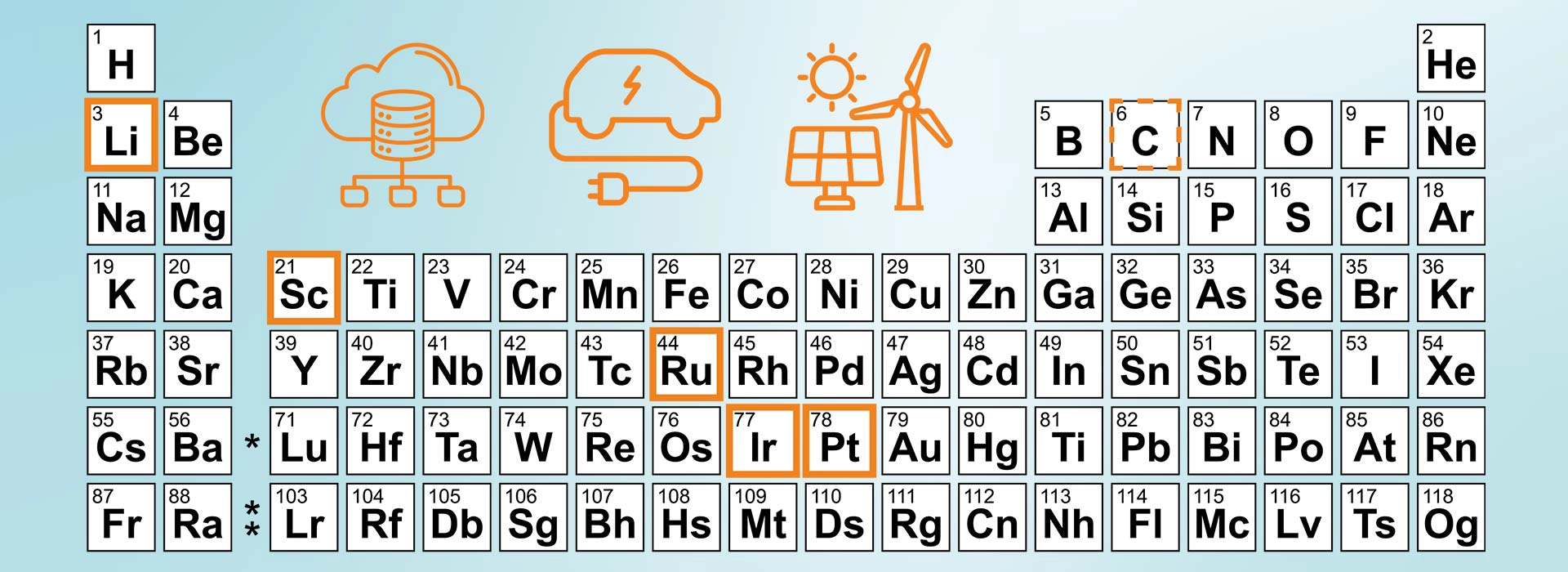
In early July 2026, the fourth study, »Raw Materials for Future Technologies,« was published. In collaboration with Fraunhofer ISI, Fraunhofer IZM developed projections for global demand for critical raw materials through 2045. The study aims to identify global »raw material hotspots.«
The study was commissioned and published by the Federal Institute for Geosciences and Natural Resources (BGR) and the German Mineral Resources Agency (DERA). The study examines 35 future technologies relevant to Germany. Fraunhofer IZM conducted an in-depth analysis of seven technologies: high-performance lithium-ion storage, high-performance microchips, microelectronic capacitors, optoelectronics/photonics, printed and flexible electronics, 5G/6G/7G, and data center storage.
The study clearly shows that various raw materials will become significantly more important in the coming years. These include iridium for water electrolysis, lithium for batteries in electric vehicles, and scandium for stationary fuel cells. Overall, a sharp increase in demand is expected for twelve metals. This also includes platinum, which is used in storage media in data centers.

Raw materials with the fastest-growing demand driven by future technologies | © Fraunhofer ISI

Raw Materials for Digitalization | © Fraunhofer ISI
RealIZM spoke with Jana Rückschloss and Franziska Maisel, environmental experts in electronics at Fraunhofer IZM, to find out more about two future technologies at the heart of e-mobility and digitalization – lithium-ion batteries and data-center storage media.
What have you noticed regarding the raw material requirements for lithium-ion batteries and storage media in data centers?
Franziska Maisel: When looking at the raw material requirements for lithium-ion batteries, the extraordinary growth in demand for lithium stands out above all else. Depending on the scenario, the demand for batteries in electric mobility could more than double over the next 20 years. Lithium is a key component of modern energy storage systems and is therefore indispensable for the further expansion of electric mobility.
In two of the three demand scenarios considered, lithium demand in 2045 will significantly exceed that of 2023 – in one scenario, by as much as eight times. Overall, this shows that lithium is a particularly critical bottleneck resource, the availability of which could significantly determine the pace of the energy and mobility transition.
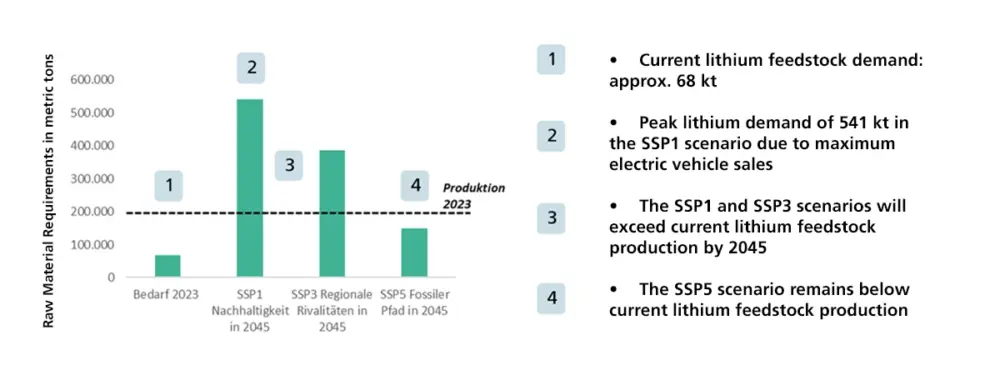
Electric mobility could increase lithium demand eightfold by 2045 – LIBs in mobile applications | © Fraunhofer IZM
Jana Rückschloss: The situation with data centers is more complex. While lithium batteries rely heavily on a single raw material, data centers require a wide variety of critical materials. A data center consists of numerous individual components. Storage media such as HDDs, SSDs, and magnetic tapes are particularly relevant in this context.
Storage Medium | Key Raw Materials Contained |
Hard Disk Drives (HDDs) | Iron, Neodymium, Praseodymium, Dysprosium, Boron, Aluminum, Cobalt, Chromium, Platinum, and Ruthenium |
Solid-State Drives (SSDs) | Silicon and Tantalum |
Magnetic Tapes | Iron, Strontium, and Barium (switch from barium ferrite to strontium ferrite) |
Overview: Critical Raw Materials in Storage Media

Platinum Demand for Hard Disk Drives (HDDs) May Exceed Production – Data Storage in Data Centers | © Fraunhofer IZM
With the rapid growth of cloud applications, AI, and data-intensive services, the global volume of data will increase massively by 2045 – depending on the scenario, by 170 to as much as 3,500 times. This also increases the demand for storage capacity and fundamentally changes the scale of demand for raw materials. More data means more infrastructure – and thus more raw materials.
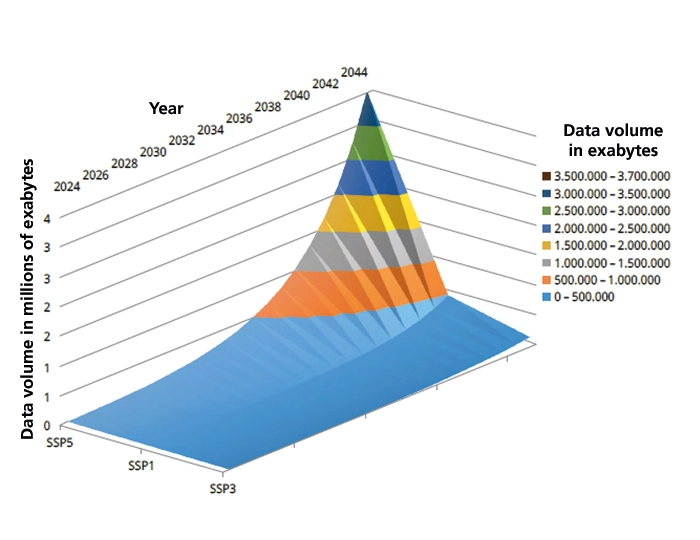
Projected Growth in Global Data Volumes in Data Centers | © Study »Raw Materials for Future Technologies 2026, « Fig. 3-49
What do these results mean in the broader context of the study?
Jana Rückschloss: The goal of this study was to identify »raw material hotspots« worldwide for the next two decades. The study serves as a guide. It is important to consider the relationship between the results rather than the absolute numbers. The projections through 2045 highlight a »range of possibilities.«
Franziska Maisel: In the broader context of the study, the results make it clear that the mobility transition and the expansion of electric mobility are inextricably linked to the issue of raw material availability. The growing demand is not an obstacle, but rather a challenge to be addressed: It shows how important a forward-looking raw materials strategy is.
The findings thus underscore that the transition to sustainable mobility can only succeed if environmental goals and a secure, responsible supply of raw materials are considered together from the very beginning. The study therefore provides an important foundation for identifying trade-offs early on and setting the course for a resilient and sustainable future of electric mobility.
How did you determine the demand for critical raw materials in data-center storage media and lithium-ion batteries used in mobile applications?
Jana Rückschloss: We derive the raw material requirements for storage media in data centers from the amount of data stored. To do this, we took into account factors such as storage density, service life, and the necessary backup copies.
»Simply put: As the amount of data increases, storage requirements rise proportionally – and with them, the demand for raw materials.«
Jana Rückschloss, Environmental Expert in Electronics, Fraunhofer IZM
Our colleagues at Fraunhofer ISI used the same approach to determine the raw material requirements for processors in data centers. For industrial development through 2045, a constant storage-to-computing-power ratio is assumed for all scenarios: 0.0073 exabytes per petaflops.
Franziska Maisel: A multi-step approach was chosen to determine raw material requirements. The starting point was various mobility scenarios, from which the total battery capacity associated with new vehicle registrations could be derived. In addition, battery sizes were researched by propulsion technology and vehicle segment, ranging from small cars to heavy-duty commercial vehicles and buses.
Based on a market estimate of the shares of various cathode materials and the specific metal quantities in the cathodes, the raw material content for lithium, cobalt, nickel, manganese, and graphite could finally be calculated. The combination of these factors provides a well-founded picture of future raw material requirements in electric mobility.
What added value does the data-volume-based approach offer?
Jana Rückschloss: The advantage lies in developing scenarios for computing capacity that are consistent with the scenarios for storage capacity in data centers. A constant ratio means that the total computing power in the scenarios increases by the same factor as the storage capacity. This allows us to forecast the raw material requirements for various scenarios for both technologies on the same basis.
The 2021 study predicted increased demand for ruthenium in relation to storage media in data centers. What is the current forecast for the year 2045?
Jana Rückschloss: In the previous study, the extreme increases in demand for ruthenium were a result of the data sources available at the time. We now have new information regarding the ruthenium content in storage media. Consequently, we have revised our forecasts downward in the current study.

Global production (BGR 2025) and raw material requirements for storage media in data centers in metric tons | © Study »Raw Materials for Future Technologies 2026,« Table 3-59
What is known about recycling critical raw materials from data centers and lithium-ion batteries?
Jana Rückschloss: Unfortunately, we are not aware of any large-scale recycling efforts in this area so far. Unlike household electronic waste, data centers are theoretically ideal for sorting equipment by type and recovering the valuable materials they contain. HDD hard drives, for example, could be specifically recycled to produce secondary magnets.
We must not forget: Data storage media are highly sensitive waste, and reliable data erasure is required. Physically destroying the storage media is a reliable method for this.
Franziska Maisel: In the case of lithium-ion batteries, recycling efforts are significantly more advanced, as recycling rates can already be taken into account. Cobalt and nickel are already being recycled today, and for lithium, the new Battery Directive now also stipulates binding recycling rates that must be met by the end of 2027 and will increase further by the end of 2031.
For manganese and graphite, however, no such quotas currently exist, which is why these raw materials have not yet been a focus of recycling efforts and, for the most part, are not yet being recovered. Overall, this shows that the regulatory framework is increasingly creating incentives for more comprehensive recycling of critical battery raw materials.
Would it be an option to replace critical raw materials in future technologies?
Franziska Maisel: Critical raw materials are used in high-tech applications primarily because they enable very specific functions. Technologists are always looking for the optimal raw material for each specific application, which is why a replacement isn’t always readily available.
However, sodium-ion batteries are a promising example: a lithium-free alternative that largely does not require critical raw materials. They are already being used today in stationary storage systems. In the long term, they could also be suitable for mobile applications, although this still needs to be researched further.
Jana Rückschloss: To replace a critical raw material, therefore, often only elements located to the right or left of it on the periodic table come into consideration. It is highly likely that these elements exhibit the same level of criticality. Only disruptive, completely new technologies may be able to circumvent criticality, fundamentally shift the market, and unexpectedly alter raw material requirements. One example is DNA-based storage technologies. These are currently on the cusp between feasibility and scalability to an industrial scale.
What recommendations for action can be derived for policymakers and the business community?
Jana Rückschloss: Identifying »raw material hotspots« serves as a wake-up call for policymakers and companies. Both the business community and policymakers must identify potential raw material shortages early on in order to minimize – and, ideally, avoid – dependencies through targeted measures.
Let’s assume a new subsidy program for water electrolysis is launched, resulting in increased demand for iridium. In that case, it would make sense to also initiate a program that secures Germany’s access to iridium.
Franziska Maisel: The study makes it clear: A rising number of electric vehicles inevitably leads to higher demand for raw materials. This is particularly evident in the case of lithium in the sustainability scenario. However, this finding must under no circumstances be misinterpreted as an argument for taking a step backward – that is, for a return to the »fossil scenario.«
Rather, policymakers and industry must take action now: We need to increase the recyclability of batteries, specifically promote »second-life« concepts, and tap into new sources of primary raw materials for batteries in electric mobility. This is the only way to meet the growing demand for raw materials in a sustainable and future-proof manner.
What can consumers do?
Jana Rückschloss: Whether you’re streaming your favorite show or using AI on your smartphone or laptop, the majority of energy and resources aren’t consumed in your own living room. The cloud isn’t a soft, fluffy cloud in the sky. On-demand services rely on large industrial-scale facilities built on open fields. They require vast amounts of resources, raw materials, and energy. It’s important for everyone to understand that digitalization isn’t intangible – it’s resource-intensive.
»The cloud isn’t a soft, fluffy cloud in the sky. (…) digitalization isn’t intangible – it’s resource-intensive.«
Jana Rückschloss, Environmental Expert in Electronics, Fraunhofer IZM
Franziska Maisel: When it comes to mobile applications like electric vehicles, consumers’ direct ability to influence matters is naturally limited, since the choice of battery technology and the raw materials used lies primarily with the manufacturers.
Nevertheless, there are steps consumers can take: They can use their vehicles for as long as possible, drive and charge in ways that conserve battery life, and thus extend the battery’s lifespan. At the end of a vehicle’s life, proper disposal is also crucial so that the raw materials it contains can be recycled.
However, the greatest leverage still lies with manufacturers and policymakers.
»The energy transition needs raw materials, but it must not fail because of them. The key lies in considering sustainability and security of supply together from the very beginning.«
Franziska Maisel, Environmental Expert in Electronics, Fraunhofer IZM
What further research do you see as necessary?
Jana Rückschloss: In media coverage of sustainability and in legislative processes, the focus has so far been on the energy consumption and emissions of data centers. Unfortunately, the issue of raw materials has not received enough attention. When assessing the environmental impact of new technologies, both topics – energy efficiency and the use of critical raw materials – are important. This study helps raise awareness of the issue of raw materials as it relates to data centers. Scientific research on this topic has been scarce so far.
Franziska Maisel: One aspect that has been neglected so far is the role of graphite. Graphite is considered a critical raw material because it is indispensable for the energy transition and e-mobility and is needed in large quantities for the production of anodes in lithium-ion batteries. At the same time, the global supply is heavily dependent on a few countries – particularly China for mining and processing – which makes supply chains especially vulnerable.
So far, however, graphite from lithium-ion batteries has not been recycled, as this is very energy-intensive and therefore not economically viable. A promising approach could be the direct recycling of the entire anode material – an area that deserves significantly more attention in future research and development.
Thank you very much for the interview!
Background Information on the Study »Raw Materials for Future Technologies«
Methodology & Data
The study focuses on four key technology clusters in which exceptional growth – and thus rising demand for raw materials – is expected by 2045:
- Mobility, aerospace,
- Digitalization,
- Electricity and Data Networks, and
- Energy Technologies and Decarbonization.
Two expert workshops were held, during which 35 technologies were selected from a set of approximately 200 potential future technologies. The final selection varies from study to study. Twenty-seven technologies from the previous study were re-examined, and eight new technologies were added.
For each future technology, the following three scenarios were examined:
- The »Sustainability Transformation« scenario analyzes the effects of sustainable development and the associated technological transformation processes.
- The »Rapid Growth in Prosperity« scenario examines the implications of a development focused on consumption and economic growth without efforts toward environmental and climate protection.
- The »Development Barriers« scenario explores how regional rivalry and a lack of international cooperation affect future development.
Funding Agency: | German Mineral Resources Agency (DERA) within the Federal Institute for Geosciences and Natural Resources (BGR) |
Project Partners: | Fraunhofer ISI and Fraunhofer IZM |
Downloads: |
 Theresa Aigner
 Alexandra Morozov
 Fabian Pranter
 Enrica Theuke
 Susann Thoma
 Dr. Michail Symeonidis
 Dr. Gunnar Böttger
 Kevin Kröhnert
 Luisa Roth