
 Dr. Michail Symeonidis
 Katja Arnhold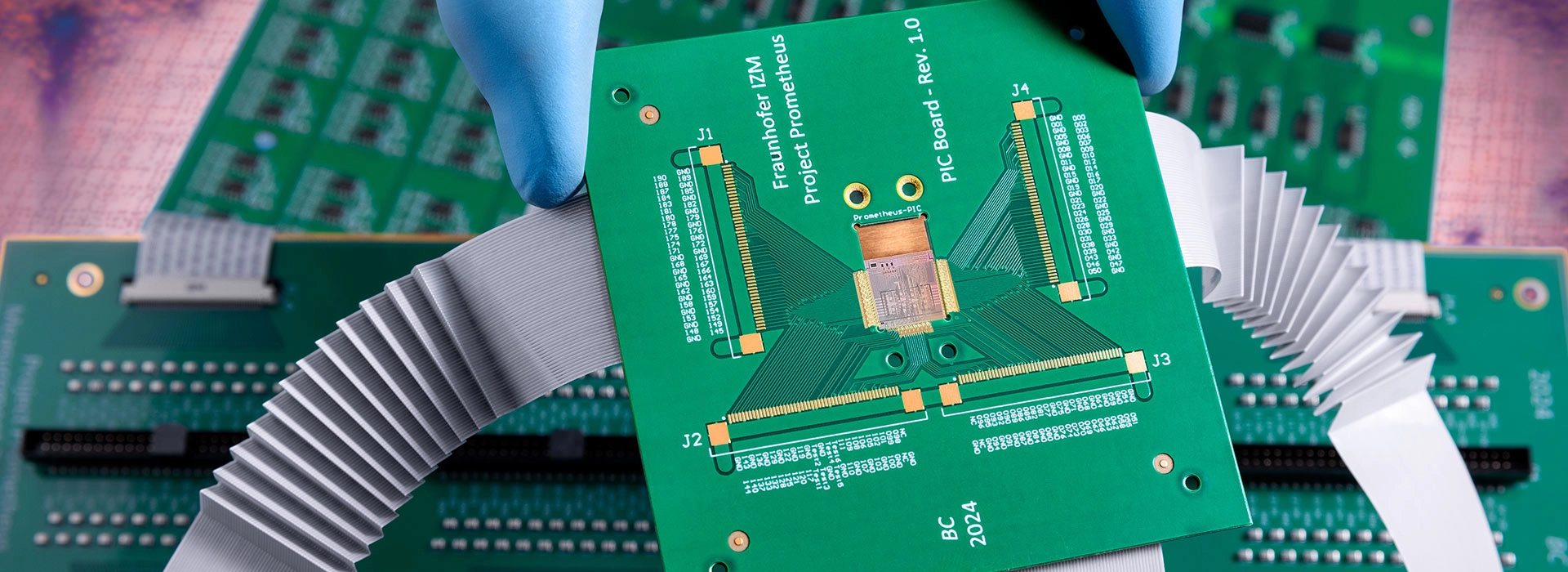
Photonics and neuromorphic systems promise a paradigm shift in data processing. The PROMETHEUS project is developing computing paradigms that complement traditional electronics – with integration and packaging playing a crucial role.
In this article
- Why Is the von Neumann Architecture Reaching Its Limits?
- How Do Neuromorphic and Photonic Computing Approaches Work?
- What Makes the PROMETHEUS Platform Different?
- Why Is Photonics a Key Technology for AI and Quantum Computing?
- What Applications Can Photonic Chips Enable?
- How Can Photonic Chips Improve Cybersecurity?
- What Is Fraunhofer IZM’s Role in PROMETHEUS?
- Why Is Packaging Essential for Photonic Systems?
- Why Was the Flip-Chip Approach Selected?
- What Technical Challenges Still Need to Be Solved?
- What Are the Next Steps for Photonic Neuromorphic Computing?
The classic von Neumann architecture is increasingly reaching its physical and energy limits. To meet the ever-growing demand for data processing, new computational approaches inspired by the human brain and nature are being researched – such as liquid state machines or spiking neural networks. These concepts have existed for decades. However, due to a lack of suitable hardware, they have not been feasible until now.
Projects like PROMETHEUS demonstrate how photonic hardware architectures can lay the foundations for energy-efficient, high-performance computers. In this interview, Dr. Michail Symeonidis explains the unique features of neuromorphic and photonic hardware platforms and the role of Electronic Packaging and integration.
»PROMETHEUS« stands for PROgraMmable integrated photonic nEuromorphic and quanTum networks for High-speed imaging, communications, and sEcUrity applicationsS. The project aims to combine neuromorphic and quantum technology on a photonic integrated hardware platform. The platform utilizes reconfigurable silicon waveguides and energy-efficient BaTiO3 phase shifters operating in the gigahertz range. Ultrafast, multi-component lasers (»neurons«) and electro-optical packaging form the basis for a standalone photonic, quantum and neuromorphic platform. It is intended to enable demanding applications – from ultrafast image processing in flow cytometry to quantum key generation and distribution.
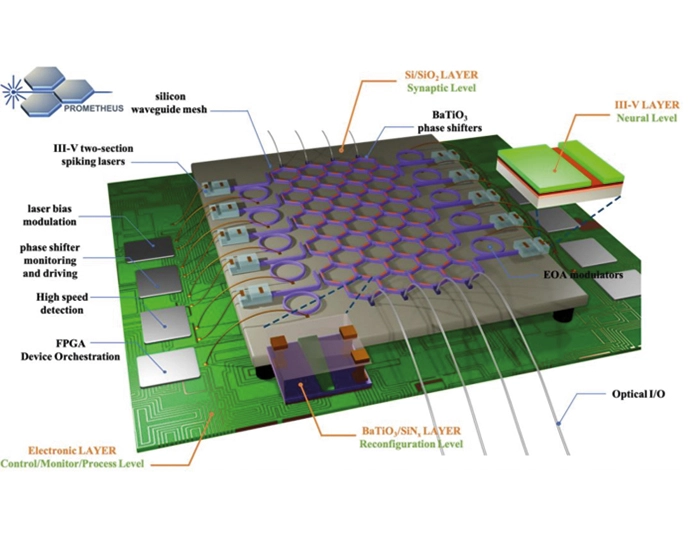
Schematic representation of the programmable photonic lattice – a so-called »Field Programmable Photonic Gate Array« (FPPGA)
What computational approaches does the photonics platform rely on?
Dr. Michail Symeonidis: The photonic processor uses light as its computational medium and dynamic, neuromorphic computing concepts such as the Liquid State Machine. To perform computations in parallel, energy-efficiently, and in real-time, signals are processed both analog and digital.
Information processing can be both analog (continuously) and digital (in discrete values). In the past, analog computing was too prone to errors due to interference and imprecise hardware. For this reason, digital systems have become the norm.
New technologies now enable a return to analog computing. To leverage the advantages of both worlds, modern systems combine both computing approaches: The future is not analog or digital, but a combination of both.
What distinguishes the PROMETHEUS photonics platform from conventional electronics or purely photonic systems?
Dr. Michail Symeonidis: PROMETHEUS combines two different computing technologies on a single chip: a photonic neural network for fast, energy-efficient AI computation and a quantum circuit for specialized, particularly complex tasks.
Thanks to the flexible interconnection of optical components, such as silicon nitride waveguides and interferometers, the chip can be configured for a wide variety of applications. Both technologies are integrated into the hardware platform and operate in parallel – like two highways for different computational tasks. Separate manufacturing processes are therefore not required. Central to this is a paradigm shift:
»It is not a single architecture that replaces everything, but rather versatile hardware platforms like PROMETHEUS that combine multiple approaches.«
Dr. Michail Symeonidis, Research Associate, Fraunhofer IZM
3D modeling, lighting, rendering, video & audio editing: Stavros Deligiannidis, PhD Script, scientific supervision: Prof. Adonis Bogris Prof. Charis Mesaritakis RESEARCH UNIT ON NEUROMORPHIC COMPUTING AND PHOTONICS (RNCP) http://rncp.eu/ Music by: bensound.com License code: NCOEOL1NTSVVI3DC
Why is interest in neuromorphic and photonic systems growing?
Dr. Michail Symeonidis: Traditional electronics is increasingly reaching its performance limits due to physical constraints, rising heat generation, and high costs. Moore’s Law is losing momentum. As a result, researchers are exploring alternative technologies such as neuromorphic and photonic systems, which enable energy-efficient and parallel data processing.
Many functions are already being replaced by optical technologies. We are currently witnessing a transition from electronic to photonic information processing – often described as an »age of light.« UNESCO symbolically marked this shift in 2018 with the »International Day of Light.«
What opportunities does the combination of neuromorphic and quantum-based photonics open up?
Dr. Michail Symeonidis: Photonics is particularly well-suited for quantum and neuromorphic systems because the physical properties of light directly support these computational principles – better than conventional electronics.
»Photonics enables computing architectures that specifically complement – rather than replace – conventional electronics.«
Dr. Michail Symeonidis, Research Associate, Fraunhofer IZM
Due to its physical properties, particularly high speed, energy efficiency, and parallelism, photonics is considered one of the crucial key technologies for future computer architectures.
What applications is the project focusing on?
Dr. Michail Symeonidis: The PROMETHEUS platform is designed for a number of applications: communications, security, and ultrafast image processing. One medical application is flow cytometry, which is used to detect the presence of particles, such as proteins.
In communication applications, both linear and nonlinear signal distortions can be corrected in real-time directly on the chip, using methods based on machine learning. The chip is very compact and can be integrated directly into devices. This shifts the computing power for high-performance computing from the data center to the edge of the system (edge computing).
You also mentioned security applications – why are photonic chips suitable for this?
Dr. Michail Symeonidis: Every chip is unique – and that is precisely what can be leveraged for security applications. Unavoidable manufacturing tolerances create a unique physical fingerprint. These Physically Unclonable Functions (PUFs) can be specifically deployed for hardware security applications.
Hardware fingerprints can be generated both electrically and optically. While traditional PUFs rely on electrical properties, photonic chips, due to their higher sensitivity, open up new possibilities for particularly complex, non-clonable optical fingerprints, and thus for a new generation of hardware-based security.
What role does Fraunhofer IZM play in the project?
Dr. Michail Symeonidis: Even the best chip in the world is worthless if it cannot be integrated and connected. This is exactly where Fraunhofer IZM comes in. Our mission is to reliably integrate new technologies and make them usable for applications.
At Fraunhofer IZM, we don’t just develop individual technologies, we create the integration expertise needed for future photonic platforms. In short:
»We turn technology into working applications.«
Dr. Michail Symeonidis, Research Associate, Fraunhofer IZM
Why is packaging crucial to the platform’s success?
»Photonic chips require electronic interfaces for control and operation. Packaging enables their implementation and system integration. To put it in more memorable terms: A chip without packaging is like an engine without a car.«
Dr. Michail Symeonidis, Research Associate, Fraunhofer IZM
For new, not-yet-standardized technologies, this requires extensive development.
In the PROMETHEUS project, light is controlled on a chip by locally altering the refractive index through heating. This method places specific demands on electrical controls and packaging and is one of several possible technological approaches.
Why did you pick the flip-chip approach?
Dr. Michail Symeonidis: The flip-chip approach enables denser integration at high electrical performance. Higher operating frequencies can be achieved thanks to the direct and very short connections between the chip and the substrate. Furthermore, flip-chip is particularly well-suited for 2.5D and 3D advanced packaging concepts and is a key process for photonic and heterogeneous integration.
What is the current status of the project?
Dr. Michail Symeonidis: The project is currently behind schedule. We have successfully designed and integrated the chips and built a system platform. The challenge lies in the scalable control of the chips. Up to 500 channels operating in parallel must be run at bandwidths in the gigahertz range, a combination for which no standardized solution currently exists.
Where are things moving next?
Dr. Michail Symeonidis: The next step is to demonstrate the flip-chip technology. To this end, a silicon interposer is being developed as the central interconnection layer on which signal routing happens. Packaging plays a crucial role here: errors or limitations in the electrical design of the photonic chip can be compensated for with suitable interposers and high-frequency routing solutions.
The photonic chip provides the central function – it is, so to speak, the heart of the system. Packaging ensures functional integration and provides the necessary infrastructure – the system’s arteries. The interposer serves as a high-precision signal network that meets the electrical design requirements and makes it possible to use the technology in the first place.
What challenges do we need to consider?
Dr. Michail Symeonidis: Packaging is no longer a downstream process, but an integral part of system design. We need an early co-design approach to guarantee the performance and integrability of modern chips. If packaging is only considered as an afterthought, there is a risk of significant technical challenges and high costs.
With the significantly higher precision needed in photonics in the submicrometer range, design, packaging, and standardization are becoming increasingly intertwined. Only a holistic approach in the sense of System Technology Co-Optimization (STCO) can hope to keep a handle on the costs and complexity in the long term.
Which factors are likely to influence the future development of packaging technologies?
Dr. Michail Symeonidis: Today, we should not look to lone wolves for innovation. It is no longer merely a question of technology, but rather the result of collaboration in networks. Factors like supply chains, the availability of resources, and coordination among project partners play a decisive role in this process.
Modern technology development is teamwork: no single institution can handle the full complexity on its own. The key lies not in mastering everything, but in pooling expertise and actively fostering collaboration. That is all the more reason why I would like to see the technologies not yet implemented in this project taken further in a follow-up project.
Thank you very much for the interview!
PROMETHEUS – PROgraMmable integrated photonic nEuromorphic and quanTum networks for High-speed imaging, communications and sEcUrity applicationS
Funding agency | Horizon Europe |
Funding amount | € 3.830.019 |
Duration | 09/2022 – 08/2026 |
Project lead | iPronics |
Project partners | iPronics, Fraunhofer IZM, IBM Research GmbH, Lumiphase AG, CEA (French Atomic Energy Commission), Ghent University, QTI (Quantum Telecommunications Italy), Scintil Photonics, University of the Aegean, IniVation, DTU (Technical University of Denmark), UniWA (University of West Attica) |
Website |
Further Reading
- H. Liu, K. Sozos, I. Teofilovic, S. Wantee, K. R. H. Bottrill, S. Malhouitre, S. Garcia et al., »200-Gbaud single-wavelength direct-detection transmission over 75 km C-band SSMF using a PIC-based recurrent spectrum slicer,« in Proc. 2026 Optical Fiber Communications Conference and Exhibition (OFC), 2026, pp. 1–3.
- K. Sozos, F. Da Ros, G. Sarantoglou, C. Mesaritakis und A. Bogris, »Recurrent optical spectrum slicers as multi-λ processors for WDM optical equalization of IM/DD channels, « in Proc. 2025 European Conference on Optical Communications (ECOC), Sep. 2025, pp. 1–4.
- G. Sarantoglou, F. Da Ros, K. Sozos, A. Bogris und C. Mesaritakis, »Reconfigurable integrated photonic chips as dual-purpose neuromorphic accelerators and physical unclonable functions,« Opt. Lett., Bd. 50, Nr. 15, S. 4842–4845, 2025.
- Y. Yue, M. Gouda, S. Sunada und P. Bienstman, »Hyper-dimensional computing for enhanced label-free particle analysis in a flow-based optical detection system,« Sci. Rep., 2026.
- R. Van Assche, S. Masaad, E. Gooskens, S. Sackesyn, J. Van Kerrebrouck, X. Yin und P. Bienstman, »Real-time all-optical signal equalisation with silicon photonic recurrent neural networks,« in Proc. 2025 European Conference on Optical Communications (ECOC), Sep. 2025, pp. 1–4.
- M. J. Filipovich, F. Horst und B. J. Offrein, »Integrated photonic lattice filter for accelerating deep convolutional networks,« in Proc. NeurIPS 2024 Workshop on Machine Learning with New Compute Paradigms, 2024.
- F. Eltes, »BTO-enhanced silicon photonics for next-generation transceivers,« in Proc. 50th European Conference on Optical Communications (ECOC), Sep. 2024, S. 594–595.
- C. Catalá-Lahoz, J. R. Rausell-Campo, D. Pérez-López et al., »High-speed non-volatile barium titanate field-programmable photonic gate array,« Nat. Photon., 2026, doi:10.1038/s41566-026-01934-y.
 Dr. rer. nat. Max Marwede
 Raphael Panskus
 Konstantina Kolovou-Kouri
 Marlot Meyer
 Pierre Wolter
 Jana Rückschloss
 Franziska Maisel
 Theresa Aigner
 Alexandra Morozov
 Enrica Theuke
 Susann Thoma