
 Theresa Aigner
 Alexandra Morozov
 Fabian Pranter
 Enrica Theuke
 Susann Thoma
The next generation of sustainable electronics may well be taking shape in the classroom. In the free online educational game world of ICT.factory, students become factory managers and make decisions about raw materials, research, and sustainability.
Together with the agency loewn and the Research Fab Microelectronics Germany (FMD), Fraunhofer IZM has developed a game-based program as part of the »Green ICT @ FMD« competence center that demonstrates how electronics production works and why sustainable decisions are so important in this context.
When Research Meets Gaming
Theresa Aigner is an expert in sustainability and the circular economy for electrical and electronic equipment. As a researcher, she specializes in precisely these areas at Fraunhofer IZM. When she and her colleagues first spoke with the game designers at the agency loewn about developing an online game on these topics, one common goal was clear: To design a game that offers a high learning impact without sacrificing the entertainment factor.
This idea gave rise to the Serious Game ICT.factory, an online game with considerable depth. Players must make strategically sound decisions along the entire value chain – from the sustainable procurement of raw materials to efficient manufacturing, the modernization of production facilities, and recycling – in order to successfully transition an aging electronics factory into the age of sustainability.
ICT.factory was developed as part of the »Green ICT @ FMD« Competence Center, funded by the Federal Ministry of Research, Technology, and Space (BMFTR). The mission of the center is to sustainably reduce the carbon footprint of digital technologies through targeted research and innovative approaches. This is because information and communication technologies (ICT) are not only an integral part of our everyday lives, but often rely on critical raw materials and generate significant amounts of electronic waste. To bring about long-term change in this situation, we need young people who not only understand the digital technologies of tomorrow, but also think sustainably from the very beginning. For this reason, the competence center is increasingly committed to promoting the next generation through various initiatives.
The abbreviation ICT stands for information and communication technology. ICT is the umbrella term for technologies, services, and processes used to capture, process, and transmit information. ICT forms the technical infrastructure of modern, digital society and is considered a driver of innovation in government, business, and various aspects of private life.
Theresa Aigner introduces the online game ICT.factory, referencing “Earth Overshoot Day” and the topic of resource consumption. | © Fraunhofer IZM | loewn
ICT.factory was created to provide an accessible entry point for raising young people’s awareness about the challenges in the field of Green ICT at an early point in their lives. »It was important to us to convey to students that the digital world we use every day is based on physical structures,« Theresa Aigner explains. »These structures require resources and energy for their production and use. We want to make knowledge about sustainable electronics accessible, while also entertaining students and sparking an interest in topics such as climate protection, environmental protection, and resource conservation.«
Another aspect was the usage scenario. The online game ICT.factory is designed for classroom use and, as such, needed to be playable on tablets, PCs, as well as smartphones – without any additional apps. The researchers and the agency developed the game accordingly as a free browser-based application.
Getting our ducks in a row: Loaded and ready to play!
This is how ICT.factory greets everyone on the screen who starts a new game. A factory complex with several buildings gradually appears – visually, it’s somewhat reminiscent of Minecraft. Shortly afterward, a first text box appears. Gamers who prefer to listen can use the audio feature in the unmistakable voice of actor and voice actor Christoph Jablonka – THE German Homer Simpson: It’s the uncle who instructs the player that he wants to pass on his old microelectronics factory to the next generation so they can lead it into the future.
Spoiler: The slightly confused but affectionate uncle with a curious fondness for ducks will appear more often as the game progresses and repeatedly make comments from the sidelines. Sometimes he’s helpful, but other times he has a snarky remark or two on his lips. Does it all sound bizarre? It only seems that way at first glance: In fact, ICT.factory is what’s known as a »serious game,« designed to raise players’ awareness of highly complex processes, such as resource consumption and sustainable production in an electronics factory. The game combines real-world challenges with a healthy dose of humor, as demonstrated by the eccentric uncle and his penchant for ducks.
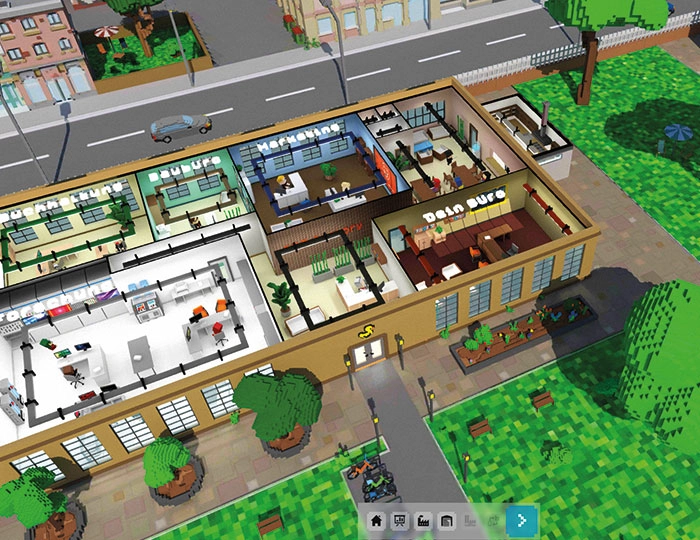
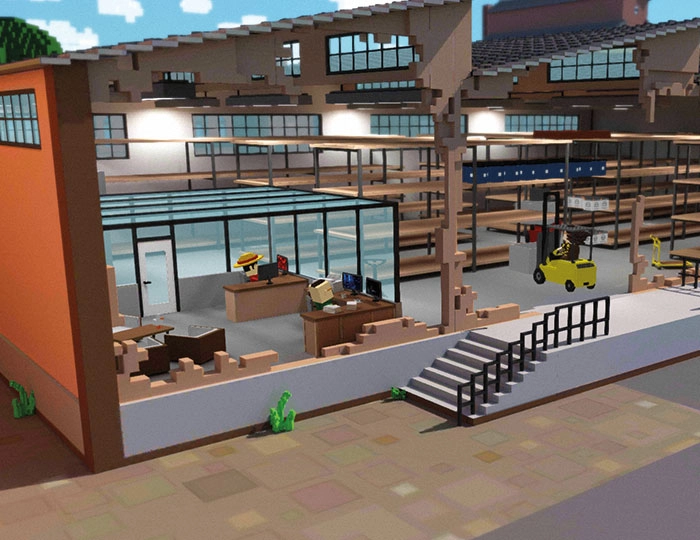
Left: A Look Inside the ICT.factory; Right: Factory at the ICT.factory | © Fraunhofer IZM | loewn
This humorous approach was deliberately chosen by the game designers and scientists. »Telling players, ›Here’s an educational game‹ – that’s the worst thing you can do,« says Fabian Pranter, managing director of the agency loewn, who was primarily responsible for the technical implementation. Instead, a »world of complete nonsense« has been created, into which players can immerse themselves and identify with the issues at stake in the game.
»ICT.factory is a vehicle for conveying serious topics.«
Fabian Pranter, lœwn | logulagu GmbH
The game’s plot revolves around the conversion and expansion of an old radio alarm clock production facility into a modern ICT factory capable of manufacturing smartphones and smartwatches. Students take on the role of CEO and actively make decisions about the procurement of raw materials, the factory’s recycling and energy management, and the resale of the manufactured goods.
Within the game itself, knowledge is conveyed through several strategies. Different technologies can be researched directly or looked up in the game’s own ›Elektropedia‹. In addition, important information based on real-world scenarios is explored in greater depth through digital newspaper articles titled ›greenICT Latest News‹, which players receive once per in-game week.
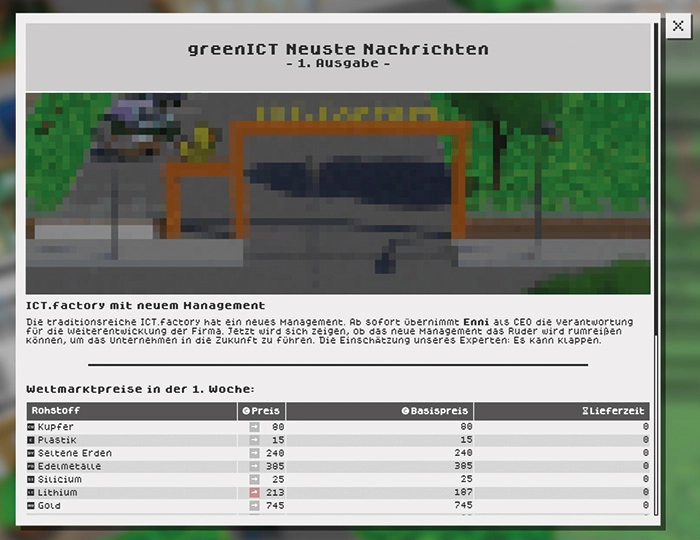
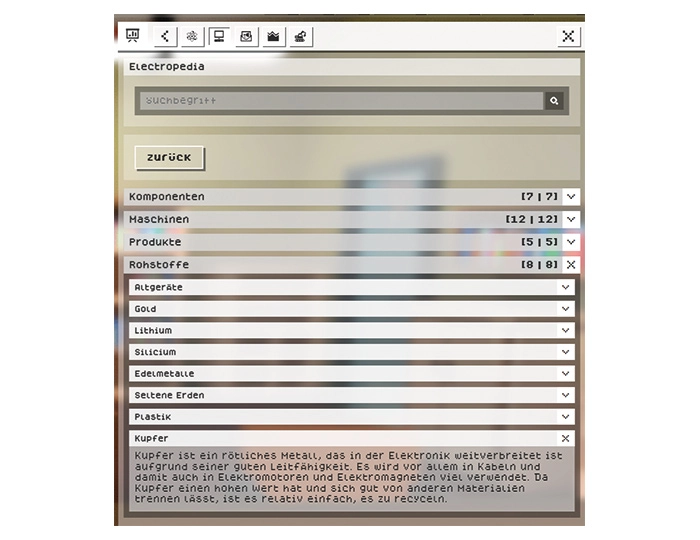
Knowledge is shared in the ICT.factory game by various means: Aaccess to Elektropedia, and newspaper articles | © Fraunhofer IZM | loewn
»We wanted to make sure the game is truly interesting and entertaining for students, so we tested it in several sessions. The feedback we received from the students in those sessions played a major role in getting ICT.factory ready for launch.«
Theresa Aigner, Fraunhofer IZM
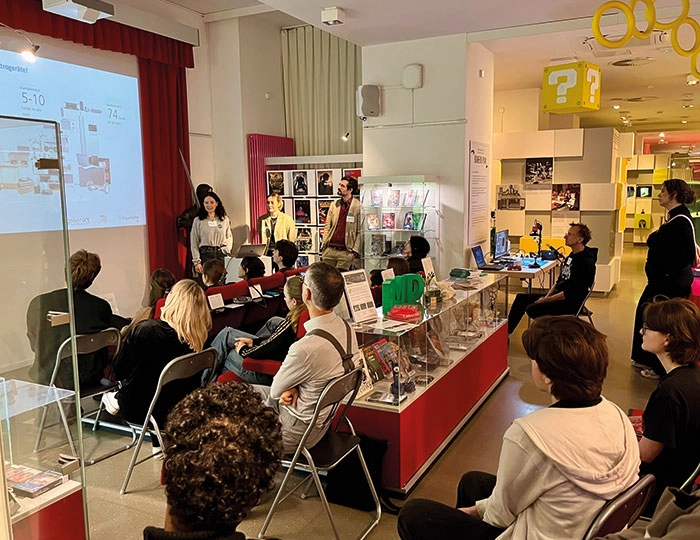
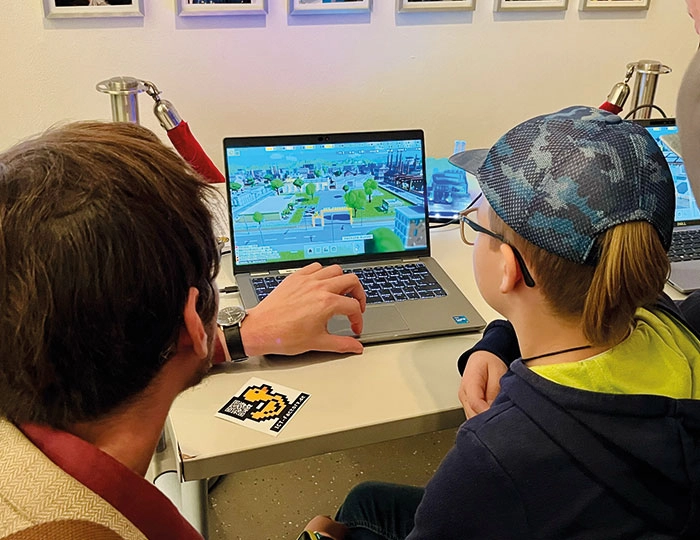
ICT.factory Launch at the Berlin Computer Games Museum on October 23, 2025 | © Fraunhofer Mikroelektronik
From the Browser to the Classroom
Because ICT.factory is primarily aimed at students, its use in the classroom is supported by a dedicated teaching concept. The worksheets and informational material available for download are designed to provide educators with guidance on how to integrate the game directly into their lessons. Comprehensive and carefully crafted materials are available for a 60- to 90-minute lesson, which can also be used by science communication advocates on project days or other STEM outreach events for young people.
»The game has great potential for classroom use precisely because, it promotes strategic thinking, teamwork, and creativity in equal measure, while also imparting knowledge and training problem-solving skills and concentration.«
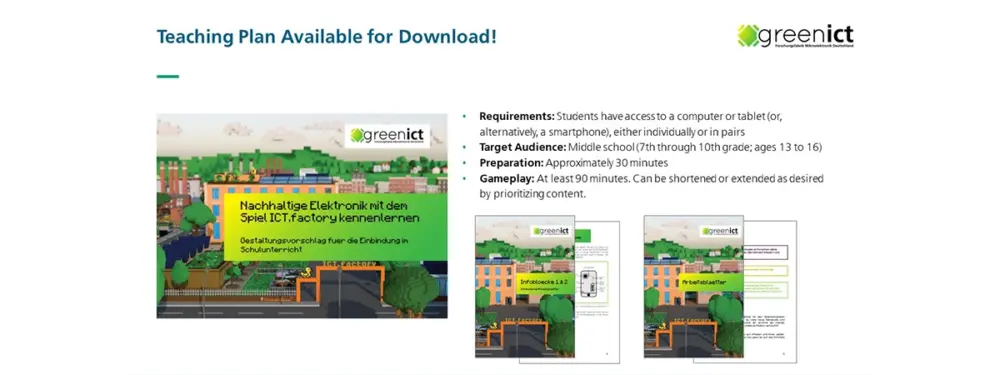
The game and accompanying educational material were created with great dedication by the researchers at Fraunhofer IZM and feature many creative details that make them usable around the world. That’s why we’re calling on all educators, STEM advocates, and science communicators: Use the game for your events and lessons, because ICT.factory shows how playing games can promote learning!
Online Game ICT.factory
Release Date | October 23, 2025 |
Version | 05/26 ICT.factory V0.9, public alpha |
Partners | lœwn | logulagu GmbH, Research Fab Microelectronics Germany (FMD), Fraunhofer IZM |
Operating Systems / Devices | Playable on all smartphones, tablets, and PCs; no installation required – play directly in the browser |
Language | German |
Project website |
 Dr. rer. nat. Max Marwede
 Raphael Panskus
 Konstantina Kolovou-Kouri
 Pierre Wolter
 Katja Arnhold
 Jana Rückschloss
 Franziska Maisel
 Dr. Michail Symeonidis