 Dr. rer. nat. Max Marwede
 Raphael Panskus
 Konstantina Kolovou-Kouri
 Marlot Meyer
 Pierre Wolter
 Katja Arnhold
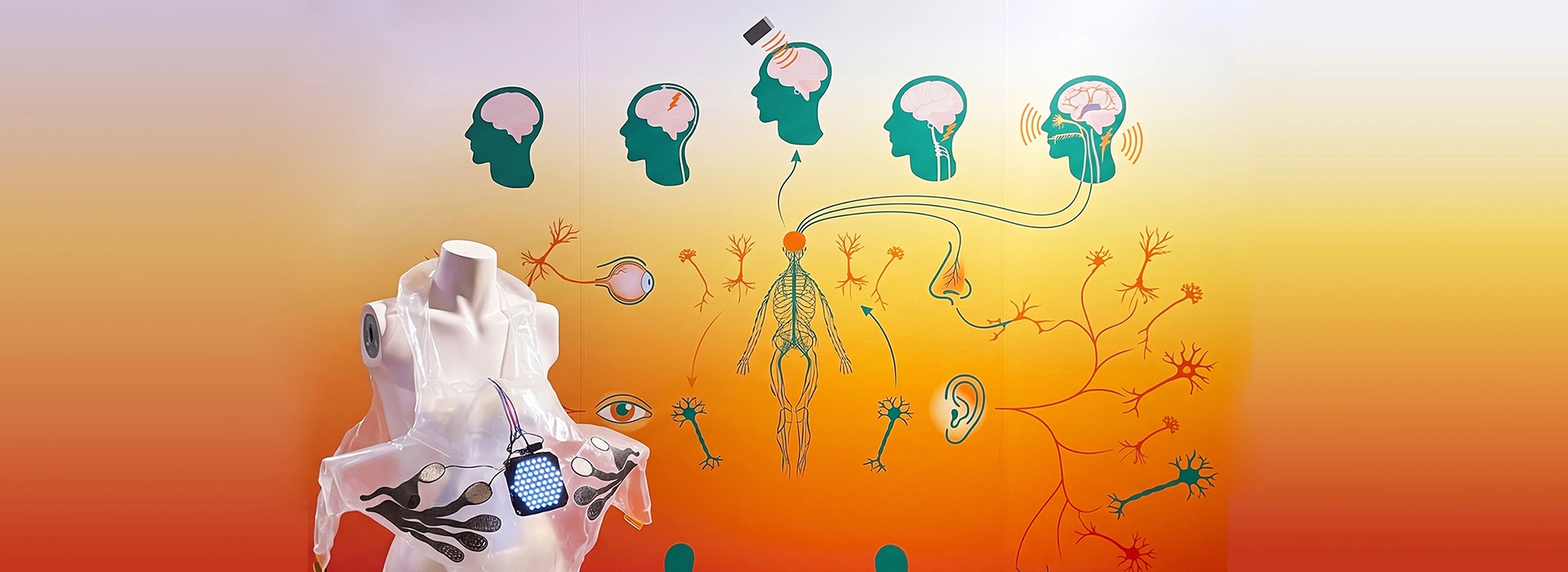
What do bats and neural microimplants have in common? In both cases, ultrasound plays an important role. The interactive sensorial artwork »Somatic Circuits« translates research from Fraunhofer IZM into sound, touch, and movement. At Berlin Science Week, visitors can become part of a network they can experience physically.
In this article
- A neural network of sound, touch, and movement
- The science behind the experience
- The art of making the invisible visible
- How art and science work together
- New impulses for research and art
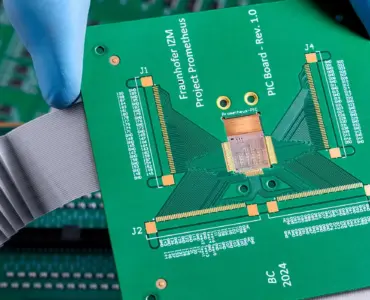
Bats use echolocation to navigate in the dark and track down prey. Researchers in the »Technologies for Bioelectronics« research group at Fraunhofer IZM are investigating how ultrasound can be used for neural interfaces and bioelectrical systems. They are developing neural interfaces that can record the electrical activity of nerve cells and stimulate the surrounding tissue.
Microimplants, such as hearing aids, are made of biocompatible, soft, and flexible materials like polyurethane, allowing them to adapt to the surrounding biological tissue. How such neural interfaces function inside the body usually remains invisible. The interactive sensorial artwork »Somatic Circuits« now turns several principles of this research into an audible, tangible, and visible experience.
Dutch-South African media artist Marlot Meyer and curator Pierre Wolter from the Gallery Art Claims Impulse developed the interactive sensorial artwork in collaboration with bioelectronic engineers and the Circular Design Lab at Fraunhofer IZM. The project is funded by the Fraunhofer Network »Science, Art, and Design« (WKD).
A neural network of sound, touch, and movement
What will visitors to »Berlin Science Week« experience at the »Somatic Circuits« interactive artwork?
Raphael Panskus: We specifically encourage visitors to touch and try out our »Somatic Circuits« interactive sensorial artwork. The artwork invites visitors to become part of a living network themselves: Each visitor wears a portable »balloon« in front of them, which represents a neuron. Each of these neurons emits a directed sound beam. This is based on focused – specifically concentrated – ultrasound. This technology also plays a role in our scientific work.
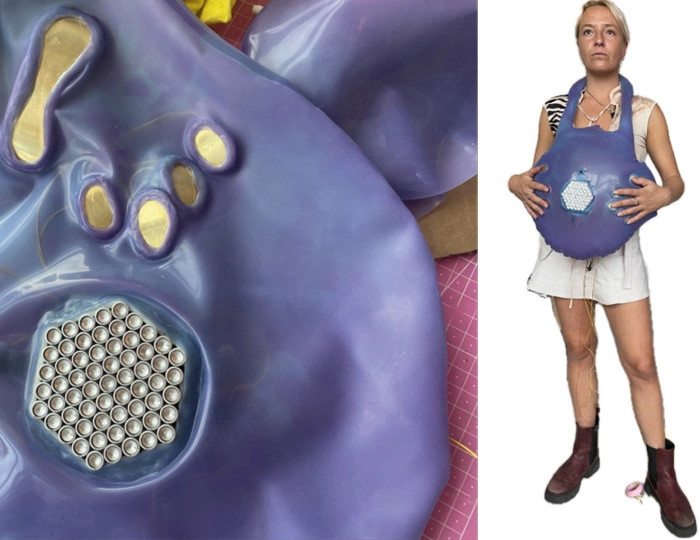
Wearables – Teil des interaktiven sensorischen Kunstwerks »Somatic Circuits« | © Somatic Circuits
Ultrasound is normally inaudible to humans. In this artwork, it is translated into a sound you can hear. But the sound becomes audible only when the directed sound wave hits a person or object and is reflected. It appears to return from the direction of the reflection.
How do the wearable neurons interact with one another?
Raphael Panskus: The participants move through the exhibition space much like bats do: they emit directed sounds, catch their echoes, and collectively create a constantly changing acoustic landscape. Their own breathing influences the sound experience: the rhythm of their breathing controls the volume of the sound they emit.
When participants touch the contact surfaces on their balloon, the transmitted and received signals can also be felt as electrical impulses in their fingers. Encounters in the space can thus not only be heard but also physically felt.
How do participants become aware that they have become part of a neural network?
Raphael Panskus: At the center of the artwork is a water-filled basin – the »central neuron.« There, the signals from all participants become visible as wave patterns. They show where signals meet, influence one another, and how strong their effect is. In this way, »Somatic Circuits« combines sound, touch, breathing, and movement in one shared physical and visual experience.
The Bioelectronics Behind »Somatic Circuits«
What Fraunhofer IZM research is behind this experience?
Raphael Panskus: I work in the »Technologies for Bioelectronics« group at Fraunhofer IZM. We research and develop miniaturized neural interfaces. Microimplants can record electrical activity from nerve tissue and stimulate it via electrodes. This allows us to create technical connections between electronic systems and the nervous system.
A key focus of our work is combining electrical stimulation with ultrasound-based measurement methods. We’re also investigating how implants can be powered wirelessly. It’s crucial to design systems that are small, flexible, reliable, and compatible with biological tissue.
What benefits can such neural interfaces offer?
Raphael Panskus: Bioelectronic systems are already being used in hearing implants. Our research explores the technical fundamentals for capturing nerve signals and selectively stimulating nerve tissue. The specific medical applications that may come from this depend on the particular research question and on further research and development.
»We research and develop miniaturized neural interfaces. With ›Somatic Circuits‹, several aspects of our research become audible, tangible, and visible.«
Raphael Panskus, research associate, Fraunhofer IZM
Which part of the research was artistically interpreted for »Somatic Circuits«?
Raphael Panskus: The artwork draws on key principles of our research: the transmission and reception of signals, their reflection, electrical stimulation, and the interactions within a network. Directed sounds, electrical impulses going through fingers, and waves on the water make these principles audible, tangible, and visible.
However, »Somatic Circuits« does not technically replicate a neural implant. The artwork translates selected aspects of the research into an artistic experience involving sound, touch, and movement. Materials and manufacturing approaches that play a role in neural interfaces were also incorporated into the development.
What can visitors learn about the research being conducted at Fraunhofer IZM?
Konstantina Kolovou-Kouri: For three days, we’re moving our workspace from the lab to the Haus der Kulturen der Welt to answer visitors’ questions. Anyone interested can talk to us directly and learn what we, as bioelectronic engineers, are researching, what materials are being used in the process, how such technologies can function within the body, and what challenges need to be overcome in the development of neural interfaces.
The Art of Making the Invisible Visible
What technical challenges had to be overcome in translating the research into a work of art?
Raphael Panskus: The technical challenge was to translate structures that are normally only a few micrometers in size into a work of art that you can walk in and wear. A neural implant is smaller than a fingernail and very thin and flexible – similar to plastic wrap. For the artwork, we scaled up micrometer-sized electrode structures from an implant to about half a meter. This corresponds to a 500,000-fold increase in length.
Microelectronics processes are designed for tiny components and structures. For this artwork, therefore, materials, tools, and processes had to be scaled up to significantly larger dimensions.
What does a 500,000-fold magnification mean?
Raphael Panskus: Imagine that a single step represents the original size. 500,000 steps of about 75 centimeters each add up to roughly 375 kilometers – which is approximately the distance between Berlin and Nuremberg.
How Art and Science Work Together
Max Marwede, you initiated this project and brought together participants from the fields of art and research. What motivated you to do that?
Dr. Max Marwede: Our research often takes place in a dialogue with colleagues in the field. But for many people, it remains a black box. Art can open a window into this black box. With »Somatic Circuits,« we make research in the field of bioelectronics accessible to a broad public.
At the same time, through the installation, we engage in dialogue with society and receive valuable feedback as well as new ideas. Art and design are not only means of making science more visible, but also a way of transforming science.
New technologies shouldn’t just function technically. We also need to understand early on what needs and expectations society has of them. Art and design can help make these perspectives visible.
»Art and design are not only means of making science more visible, but also a way of transforming science.«
Dr. Max Marwede, research associate, Fraunhofer IZM
The project’s unique approach lies in the collaboration between art and science. What did this co-creation look like?
Marlot Meyer: »Somatic Circuits« was developed within the Fraunhofer network »Science, Art, and Design.« Together, we sought ways to make signal transmission, touch, and the stimulation of the human body artistically tangible. This resulted in an interactive sensorial artwork of wearable balloons that translates aspects of neural interfaces into a physical and spatial experience.
What conceptual challenges did you have to overcome in the process?
Marlot Meyer: Art and science deal with interim results differently. At first, it felt unusual to me to publicly display an unfinished test version at the »Festival der Zukunft« in Munich. For me, an important part of a work of art is its ability to immediately convey a concept or a feeling. A work that is still in the process of being created requires a lot of explanation in the form of words and images, and it raises questions in the audience. However, the audience’s feedback helped us develop the artwork further.
Konstantina Kolovou-Kouri: We researchers, too, had to challenge our usual process. This productive friction opened up new ways of making scientific principles tangible. The result was not merely an illustration of research, but a collaborative development process that incorporated both perspectives.
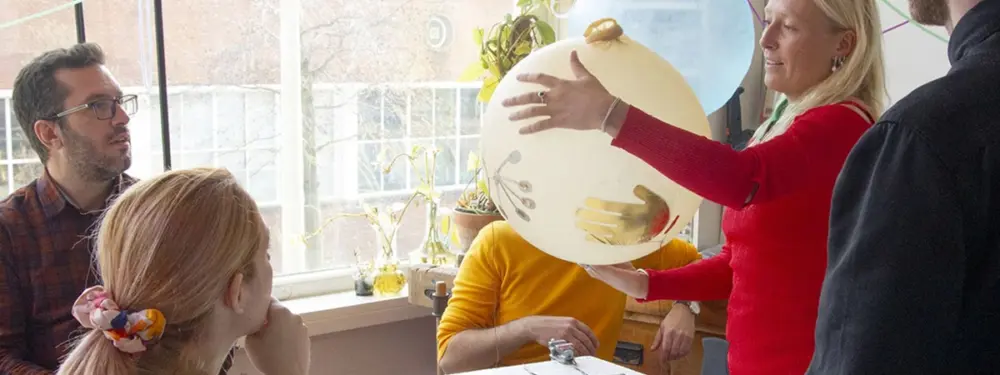
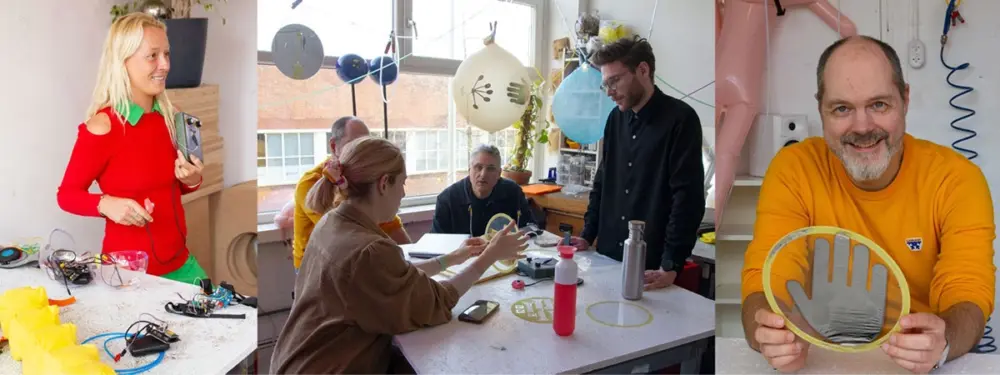
Brainstorming session with Fraunhofer researchers from the fields of bioelectronics, ultrasound wearables, and sustainable design, along with curator Pierre Wolter and artist Marlot Meyer at her studio in The Hague. © Somatic Circuits
Why is »Berlin Science Week« the right venue for »Somatic Circuits«?
Marlot Meyer: Science festivals convey a lot of information. »Somatic Circuits« complements this knowledge transfer – in an experience-oriented way – by adding a physical experience. Participants encounter scientific concepts through sound, movement, and touch. At the same time, they become more aware of their own bodies and their reactions.
»Science festivals convey a lot of information. ›Somatic Circuits‹ complements this knowledge with a physical experience.«
Marlot Meyer, media artist
New Impulses for Research and Art
What has this collaboration opened up for you as researchers?
Raphael Panskus: Through artistic prototyping, we were able to test materials under conditions different from those in the lab. This revealed, for example, that a titanium layer may not be necessary for gold adhesion. Whether this also applies to our research remains to be investigated. However, this example shows that artistic experiments can usefully complement research. Joint funding opportunities would be important for continuing such collaborations.
What’s next for the artwork?
Pierre Wolter: As a curator, I see great potential for further exhibitions; concrete discussions are already underway with »Ars Electronica« for the coming year. To ensure that »Somatic Circuits« can endure and continue to evolve in the long term, we are clarifying funding, responsibilities, as well as copyright and ownership rights.
Media art is an archive of the technology of its time. Technology becomes obsolete. In technology-based art, therefore, it must also be specified which components may be replaced or reinterpreted in the event of technical change. One could speak of a kind of »artistic will.« It is also important that the participating researchers have a say in decisions even if the institution changes.
Thank you very much for the interview!
Berlin Science Week
📍 November 6–8, 2026, at the Festival Center – Haus der Kulturen der Welt (HKW)
John-Foster-Dulles-Allee 10, 10557 Berlin, Germany
More Articles on Neural Implants and Bioelectronics
Neural interfaces form an important foundation for future applications in neurotechnology, medical technology, and personalized healthcare.
This article is part of our topic area Neural Implants and Bioelectronics. In the topic overview, you will find additional RealIZM articles on implantable microsystems, wireless power supply for medical implants, and innovative electronic systems for diagnostics and therapy.
 Theresa Aigner
 Alexandra Morozov
 Enrica Theuke
 Susann Thoma
 Dr. Michail Symeonidis