
 Theresa Aigner
 Ronja Scholz
 Katja Arnhold

Did you know that recycled plastics must deliver different peak performance levels depending on their application in electronic devices? From kitchen composters that withstand acidic liquids, to kitchen appliances subject to the strictest food safety regulations, to ESD-compliant logistics pallets, flame-retardant housings for electric chargers, and sensitive medical applications such as electric toothbrushes. Each of these electronic products places its own – often extreme – demands on material properties, safety, and quality.
How can plastics from high-quality electrical appliances be reused? How can the proportion of recycled material in these applications be successfully increased? And at what point in the manufacturing chain – and among which stakeholders – does recycling actually begin? These key questions were examined by the EU project »INCREACE« (Increase the share of recycled plastics in added value products).
RealIZM spoke with Theresa Aigner and Ronja Scholz, experts in environmental electronics at Fraunhofer IZM, about the results of the research project. We provided a detailed overview of the background of »INCREACE« at the start of the project.
In this article
- Who Decides the Recyclability of Electronic Devices?
- How Is the Recyclability of Electronic Devices Assessed?
- Repairability vs. Recyclability: What Are the Differences?
- What Did the INCREACE Project Achieve for Electronic Device Recycling?
- Why Is the Share of Recycled Plastics in Electronic Devices Still So Low?
- What Is Needed for a Circular Economy in Electronics?
- What Research Challenges Remain in Electronic Device Recycling?
Recyclability is a systemic decision
Do you agree with the statement: »Recycling an electronic device starts with the design«?
Ronja Scholz: I can only partially agree with that statement. Yes, the groundwork for a product’s recyclability is laid during the design phase. But design alone isn’t the deciding factor. As an industrial designer, I know from my own experience that the power to make design decisions regarding the recyclability of electronic products lies with manufacturers as well as with policymakers. Recycling begins with design, but the responsibility lies with multiple stakeholders.
»Recycling begins with design, but the responsibility lies with multiple stakeholders.«
Ronja Scholz, Research Associate, Fraunhofer IZM
Theresa Aigner: Three key factors are crucial for successful and long-term sustainable product development: appeal, feasibility, and profitability. The product must be manufacturable using available technologies and materials, solve a real problem or meet users’ needs, and also be financially viable for the company. A product concept only stands a chance on the market if these three factors are balanced.


From left to right: Material comparison (from left to right): shredded Varoma lids as raw material, primary plastic (reference material), recycled material, and compound material for the Philips demonstrator. | From an end-of-lifeCopier to a Product: Stages in the Development of Recycled Material Use – from raw material to recycled material to the Philips demonstrator for electric toothbrushes. | © INCREACE
During the research project, we spent a long time discussing whether recycling should be viewed as a fourth, separate pillar or as an overarching, unifying element. Our conclusion is: Sustainability is not an optional extra, but a fundamental requirement for design in product development. Hence our thesis: Recyclability should be considered from the outset and weighed alongside every other design decision.
»Sustainability is not an optional extra, but a fundamental requirement for design in product development.«
Theresa Aigner, Research Associate, Fraunhofer IZM

© INCREACE | Arno Wolters
The INCREACE playbook »Developing Recyclable Electronic Devices: A Playbook for Design for & from Recycling« presents approaches to recyclable product design that demonstrate how design, material development, and recycling can be more closely integrated.

Playbook »Developing Recyclable Electronic Devices« | © INCREACE
How was the recyclability of plastics investigated in the project?
Aigner: Five case studies were used to demonstrate the technical, regulatory, and functional conditions under which the use of recycled materials is already possible – and where there is still a need for further development. These examples also formed the basis for the Recyclability Assessment Tool (RAT) and the material development in the project.
- Kitchen composters: The plastics must be permanently resistant to acid and moisture while remaining dimensionally stable, leak-proof, and durable.
- Kitchen appliances: The plastics must be food-contact compliant and able to withstand intensive use involving heat and steam.
- Electric toothbrushes: The housing must meet strict requirements for skin compatibility, chemical safety, and quality – while also meeting high standards for design and surface finish.
- Electric chargers: Housings must meet high fire safety requirements and withstand high temperatures and electrical stresses – often while maintaining a sophisticated appearance.
- Logistics pallets: Materials must dissipate electrostatic charges in a controlled manner while also being mechanically robust.
How can the recyclability of electrical appliances be objectively assessed?
Aigner: To accurately assess recyclability, three key factors must be considered at the product level: First, material types such as base polymers, additives, and fillers; second, joining methods such as screws, snap-fit connections, and adhesives; and third, surface coatings such as lacquers or paints that could make separation more difficult.
As a key outcome of the INCREACE project, product developers now have access to a free Recyclability Assessment Tool (RAT) for benchmarking the recyclability of small household appliances such as electric toothbrushes, toasters, and vacuum cleaners. The assessment tool evaluates how recyclable a product is within the current recycling system and provides specific guidance on where there is room for improvement.


From left to right: Philips demonstrator for electric toothbrushes featuring product and material samples made from dissolution-based and chemical recyclates. | Philips Demonstrator: Handles for electric razors made from recycled materials from the INCREACE project (various product and material samples). | © INCREACE
Scholz: This allows critical factors that could impair a product’s recyclability to be identified early in the development process. The tool is based on many years of experience in analyzing electronic waste. It was jointly developed by Philips and the PEZY Group and tested and refined as part of the project.


Tool for design and product development teams to plan and evaluate recyclable designs | © INCREACE
The Trade-Off Between Repairability and Recyclability
Can a product be both optimally repairable and optimally recyclable at the same time?
Scholz: With end-of-life electronic devices, the type of fastening, among other factors, determines how well a device can be recycled or repaired. Snap-fit connections are often more recycling-friendly because they can be broken apart more easily. Screw connections are more repair-friendly. They allow a housing to be opened and closed multiple times, which is essential for repairs and maintenance.
However, plastic components can be lost during the recycling process. The reason for this is that, after shredding, screws and the plastic parts attached to them are recognized together as metal-containing material and sorted into the metal stream. The plastics are not recovered separately in this process. Recyclable does not necessarily mean repairable, but overall, easier disassembly is also better for recycling.
From an environmental perspective, the key question is therefore not ›What is better? ‹ but ›What is more effective?‹ Ideally, repairability and recyclability are considered together. For electronic devices, a long service life is almost always the best option these days, so it should not be compromised at the expense of recyclability. Companies should define clear priorities and measures along the entire value chain.
How do you measure the success of the research project?
Scholz: Our most important finding is the proof that all five demonstrators can be manufactured using recycled materials. The focus was not on the quantity of recycled materials, but on their quality – from breaking strength and toughness to color. And we were able to demonstrate that new sorting and analysis methods help make recycled materials efficiently available for demanding applications.
At the same time, the project has made it clear why the proportion of recycled materials in electrical and electronic equipment – currently at 3.2 percent – is still so low. To be able to use suitable recycled materials in a targeted manner, we need to better understand which plastics are used in which products today. Only then can we determine which secondary raw materials will be available in the future. This approach follows the concept of urban mining.
Aigner: For particularly demanding requirements – such as in food contact applications – traditional recycling processes are not always sufficient. That is why, as part of the project, we also investigated innovative approaches such as dissolution-based recycling to make high-quality recycled materials usable even for particularly demanding applications.
Learn more about plastic recycling in electronics
In the Green ICT online course »Plastic Recycling in ICT Products,« Theresa Aigner explains how plastics from electrical and electronic devices are recycled, what challenges are involved, and why high-quality recycled materials are crucial for a functioning circular economy.
▶️ Watch the Green ICT online course now
Learn more about circular design for electronics
In the Green ICT online course »Circular Design for ICT Products,« Ronja Scholz explains why the recyclability of electrical and electronic equipment must be considered as early as the product development stage. The course shows how design decisions influence future repairability, reusability, and recyclability, and what role circular design plays in a successful circular economy.
▶️ Watch the Green ICT online course now
The technology is available – now we need market support and policy action
Why is the proportion of recycled materials in electronic devices still so low?
Aigner: Electrical appliances consist of a complex mixture of metals and plastics that are firmly integrated with one another. For e-waste recyclers, high-quality and expensive metals like copper and gold are the most lucrative. Depending on the price of crude oil and the price of virgin plastic, either recycling or incinerating plastics is the more attractive option.
To make matters more difficult, plastics are not as easy to separate as metals. Not all plastics are the same; they differ in color, additives, and polymer types.
What is needed for a scalable circular economy?
Aigner: In the EU, more than 2.6 million metric tons of plastic waste are generated annually from electronic waste. Unfortunately, too little high-quality plastic is currently making its way into the recycling stream. Many plastics are therefore downcycled. INCREACE has shown that it is possible to improve quality. This approach needs to be implemented on a larger scale.
Scholz: This requires long-term offtake agreements that secure investments in recycling technologies. Policy measures such as recycled content quotas provide additional support. At the same time, clear rules and incentives are needed to make secondary raw materials more attractive and to make material cycles economically viable.
What challenges and research questions still need to be addressed for a successful circular economy?
Scholz: A key research question is: Which circular strategy is the right one for which product – repair, reuse, component harvesting, or recycling?
Aigner: Greater standardization is just as important. More uniform material requirements would significantly improve the recyclability of many products.
Thank you very much for the interview!
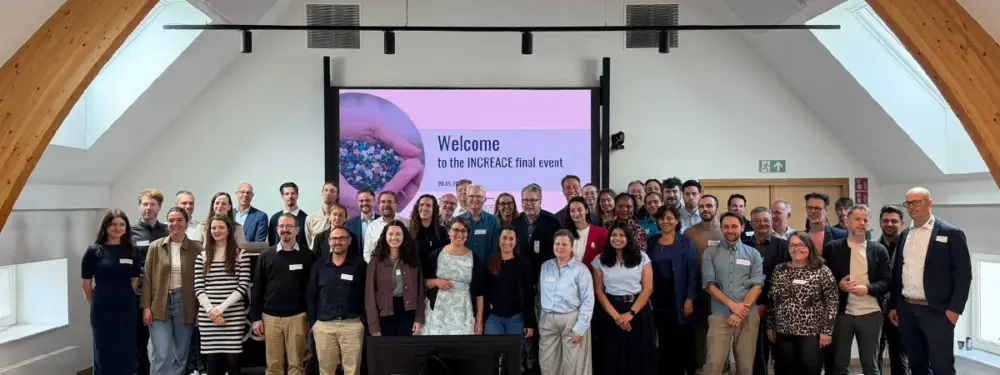
The INCREACE project team and external guests at the closing event. | © INCREACE
How to Improve the Availability and Quality of Recycled Plastics in Electronic Products | © Circular Design Lab at Fraunhofer IZM
INCREACE – Increase the share of recycled plastics in added value products
Funding Agency | European Health and Digital Executive Agency (HaDEA) |
Funding Program | Horizon Europe |
Grant ID | 101058487 |
Funding Amount | 7.289 million € |
Duration | June 2022 – May 2026 |
Project Partners | Fraunhofer Society for the Advancement of Applied Research – (Fraunhofer IZM as coordinator, Fraunhofer IVV as project partner), Flemish Institute for Technological Research (VITO), Catholic University of Leuven – KU Leuven, Pezy Group, Plastika Skaza, Vorwerk Elektrowerke GmbH, Neste Oyj, Partners for Innovation, Mirec, Cabka Spain Sociedad Limitada, Maastricht University, SAP SE, EGEN, Philips Electronics Nederland, Erion Compliance Organization S.c. a r.l., Cloud Selling, ETH Zurich |
Project website |
Explore More: Circular Electronics and Sustainable Product Design
Creating more sustainable electronics requires action throughout the entire product lifecycle. From the use of recycled materials and transparent product information to longer-lasting products, these articles highlight key building blocks for a circular economy in electronics.
-
Challenges and Opportunities: The Road to More Recycled Plastics in Electronics Products
Discover the barriers to using recycled plastics in electronic products and the opportunities they offer for reducing resource consumption and closing material loops. -
Digital Product Passports: Paving the Way for a Sustainable Circular Economy
Learn how digital product passports can improve transparency, support recycling processes, and enable more sustainable product management. -
Repair instead of Discard: New Test Method for Standardized Assessment of Electronic Products’ Lifetime
Explore how a standardized approach to assessing product lifetime can promote repairability, extend product use, and help reduce electronic waste.

 Alexandra Morozov
 Fabian Pranter
 Enrica Theuke
 Susann Thoma
 Dr. Gunnar Böttger
 Kevin Kröhnert
 Luisa Roth

 Dr. Chris Eckstein
