
 Tapani Jokinen
 Dr. phil. Lutz Stobbe
 Katja Arnhold
 Luisa Roth
WLAN routers are ubiquitous. The fact that their casings are often made of plastic poses various challenges for recycling. In the research project »ALU4CED« (»Aluminum-based multifunctional housing for circular electronic devices«), a German-Polish consortium of researchers and industry representatives, with the participation of Fraunhofer IEM and Fraunhofer IZM, has developed a sustainable router made of aluminum. As part of this effort, it tested the use of laser direct structuring (LDS) for the integration of antennas in housing.
The resulting router meets the requirements of the current EU Ecodesign Directive, does not require plastic housing, and uses more compact circuit boards – a step toward recyclable, resource-saving devices.
RealIZM spoke with Tapani Jokinen, an expert in circular design, and Dr. Lutz Stobbe, head of the »Sustainable Networks and Computing« working group at Fraunhofer IZM, to learn more about the design process and the results of the research project.
Design meets sustainability
Wi-Fi routers are mass-produced devices that tend to fall in the category of hardware that people prefer to hide rather than display. »Our goal was to develop a resource-saving, aesthetically appealing, multifunctional body for circular electronic devices,« says Tapani Jokinen. At first glance, the use of aluminum appears to be less environmentally friendly, as the carbon footprint for the production of aluminum is higher than for plastic. However, the picture changes when you think long-term and consider that aluminum can be recycled much better than plastic and that recycled aluminum has a similarly low carbon footprint to plastic.
However, this requires a material-saving device design that also directly addresses the easy separation of the essential material fractions, i.e., the circuit board and the aluminum housing. This is how Tapani Jokinen describes the starting point of his work. The design brief was crucial for this and was established early on in the Alu4CED project:
- High-tech design with a utilitarian, but premium appearance (aluminum)
- Symmetrical one-piece body with mirrored front and back
- Optimized thermal management that takes into account the positioning of the active components on the circuit board and a low-loss thermal transition to the housing. Cooling fins have also been integrated into the covers.
- Recyclability: easy (dis)assembly with standard tools and breakable screw chucks for the fastest opening of the device during recycling
- Easy installation on table and wall without additional tools
- Modular design for easier repairs, upgrades, and an extension of the device’s service life from seven to ten years
- Material and manufacturing efficiency: low material consumption and variety (material-optimized and reduced use of plastic)
- Optimization of the form factor of the circuit board for very high area yield on the manufacturing format
- Multifunctional design and high degree of integration: UI touch bar and 5G picocell LDS antennas are integrated into the body, while the body itself provides cooling.
- LCA-driven Design Development: The design was continuously supported by accompanying life cycle assessments.
Aluminum body as a game changer for sustainable Wi-Fi routers
A suitable material was selected for the body, based on the design objectives. The researchers opted for aluminum in order to combine aesthetics and sustainability, as well as durability. Aluminum offers several advantages: First, it can be recycled multiple times without any loss of quality. Second, the carbon footprint of recycled aluminum ranges from 1.0 to 6.0 kg CO₂e per kg, which is far below the 15.1 kg CO₂e per kilogram of primary aluminum — a saving of 60% to 93%.
The carbon footprint for new high-quality plastics is between 3.0 and 5.0 kg CO₂e and for recycled plastics between 0.5 and 1.5 kg CO₂e. For the calculations of the LCA scenarios in the Alu4CED project, 2.9 kg CO₂e was therefore used for average primary ABS (acrylonitrile-butadiene-styrene copolymer(s)) and 0.6 kg CO₂e for recycled ABS.
Saving material and space thanks to integrated RF and heat transfer
»The choice of aluminum for the router body enables innovative manufacturing technologies and multifunctional structures – for greater sustainability and resource conservation,« explains Jokinen. Thanks to a special laser direct structuring (LDS) of a coating, the three-dimensionally shaped aluminum surface is multifunctional: »The innovation lies in integrating the antennas directly into the surface of the body.«
The inside is put to use for heat transfer purposes. The antennas and sensors are integrated directly into the shell. The LDS coating has good high-frequency properties and allows the integration of RF structures and antennas for 6 GHz. To achieve this, Fraunhofer IEM adapted 3D MID (Molded Interconnect Devices) technology. Until now, this process was only ever used for plastics. LDS technology enables more individual structuring and 3D structures of the conductor tracks, thus offering greater design freedom.
The technical innovation not only affects the functionality, but also the environmental footprint of the router. »The multi-purpose body fulfills key objectives of the research project, such as reducing material consumption, optimizing space utilization, and using recyclable materials,« Jokinen explains.
Compact aluminum body and integrated antennas optimize eco-balance
»Our ecodesign concept saves previous resources: we have replaced plastic with recycled aluminum and reduced the volume of the router by 17% compared to the reference router. Less material, less waste – thanks to optimized circuit boards and antennas integrated into the body,« says Dr. Lutz Stobbe discussing the key technical advances of the project.
As a result, the manufacturing eco-balance of approximately 16 kgCO2e for the new eco-design concept was reduced by around 6 kgCO2e compared to the conventionally manufactured router with just under 22 kgCO2e. The primary savings result from the reduction in circuit board area and the increase in area yield during circuit board production. The use of recycled aluminum also contributes significantly to the improvement.

Breakdown of the CO₂ footprint of manufacturing by main components for the conventional design (scenario 1A) and the ecodesign router (scenario 2A). | © Fraunhofer IZM
Innovative body integration
Another advantage of aluminum is its excellent thermal conductivity, which is indispensable given the increasingly powerful components. »We managed to integrate heat sinks, all components, and fasteners for the circuit board directly into the aluminum body,« Jokinen points out. This dissipates heat effectively and eliminates the need for additional cooling solutions.
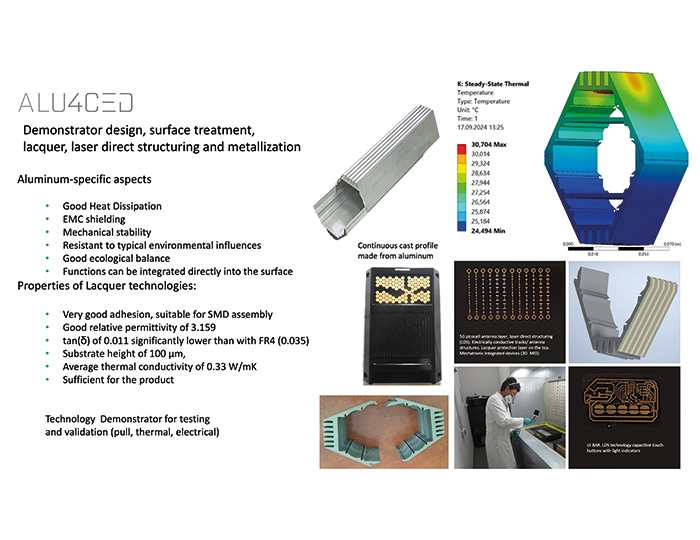
Technology demonstrator for testing and validation (pull, thermal properties, electrical properties) – various views of the LDS structure, cast aluminum profiles, thermal tests, and laboratory tests | © Fraunhofer IEM
Jokinen adds another special feature: »Aluminum offers a wide range of design options in terms of color and surface finish.« The preferred method of surface finishing, both technically and ecologically, is anodizing. This involves using an electrochemical process to create a controlled oxide layer of aluminum oxide that is firmly bonded to the base material. This layer is extremely thin, non-toxic, and corresponds to the natural oxidation of aluminum. It increases the corrosion resistance and abrasion resistance of the material without compromising its purity. Since no foreign substances are applied, the aluminum remains fully recyclable.
Two design variants
The goal was to develop the most environmentally friendly and resource-efficient Wi-Fi router possible. Jokinen explains: »We opted for a body with identical front and rear sides. This saves us manufacturing costs and production time.« A single mold is sufficient, and fewer components and a capacitive touch bar increase the degree of integration. The functions are distributed symmetrically on both sides. Fins ensure efficient heat dissipation.
Many routers require additional plastic mounting brackets for wall mounting. This increases complexity and costs. Jokinen and his team propose a flexible leather or fabric hook instead. This is multifunctional and can also be used for clothing or bags.

Wall hook concept for the ALU4CED router | © Fraunhofer IZM I Tapani Jokinen
To prove the feasibility of the design, a functional demonstrator (Ultra 1) was created in the research project. The LDS technology was tested with this prototype. In addition, a show-car-like design concept (Ultra 2 Compact) was created to visualize how a later series product would look and feel. The primary goal was to further reduce the size and complexity of the router. Thanks to smart cable management, the router now has only one USB-C port – its power adapter delivers both power and data over one single cable instead of multiple connections.
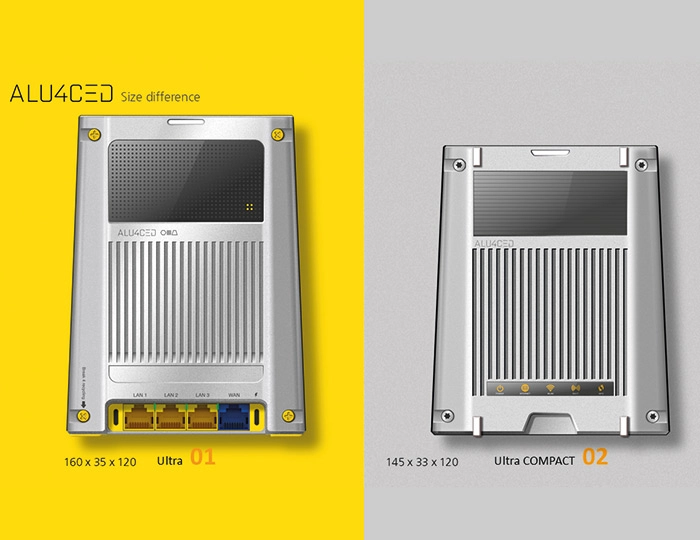
Design concepts Ultra 1 and Ultra 2 Compact | © Fraunhofer IZM I Tapani Jokinen
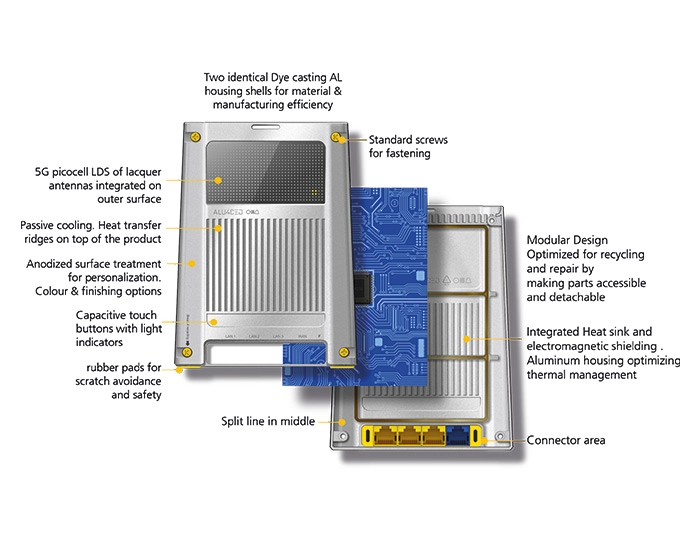
Design concept Ultra 1 | © Fraunhofer IZM I Tapani Jokinen

Ultra Compact 2 design concept | © Fraunhofer IZM I Tapani Jokinen
Beyond saving materials and energy, the project takes a holistic ecodesign approach that considers the entire product lifecycle.
Ecodesign as a systematic approach
»With the ecodesign approach, we are reducing the environmental impact of consumer electronics,« Stobbe explains. »The Circular Design Lab team at Fraunhofer IZM is developing sustainable and reliable electronic systems using an LCA-driven design approach.«
First, the environmental experts for electronics identify the hotspots in the product lifecycle that have the greatest environmental impact. New, more environmentally friendly materials and processes are then selected for the identified hotspots.
Stobbe and Jokinen agree that the »sustainable design framework« includes not only product design, but also services such as repair and maintenance. Circular design goes beyond the product, service, and system and takes into account its entire impact and life cycle according to the »cradle to cradle« principle. This means that manufacturers have an extended responsibility for their products from creation (»cradle«) to reuse (»cradle«).
»Every product is a repository of valuable materials and should be designed so that these can be reused in a meaningful way,« explains Jokinen.
This meant that a key goal of the research project was ensuring the recyclability of the Wi-Fi router. The researchers analyzed recycling methods and derived suitable design proposals from them. An important part of this approach is the question of how recycling and repair can be optimally taken into account in the design process.
Recycling and repair reimagined
The recycling rate indicates the percentage of a device that can theoretically be recycled. This requires materials and designs that enable single-type recycling. Adhesive joints and snap fasteners are common in Wi-Fi routers. It is practically impossible to open the housing without damaging it. Screw connections are easy to dismantle, but they require manual labor.
To make the router easy to maintain and enable its materials to be recycled efficiently, the researchers proposed an innovative solution: a plastic thread allows the housing to be opened quickly. Whenever it needs to be repaired, the connection can be opened and screwed back together again with a screwdriver.
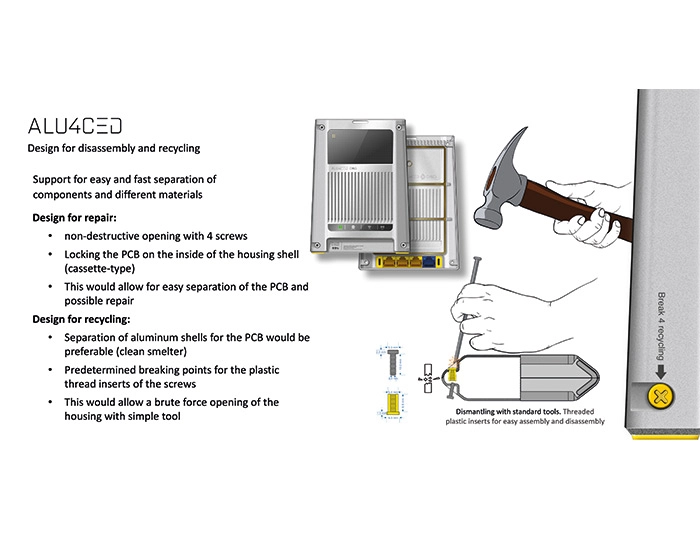
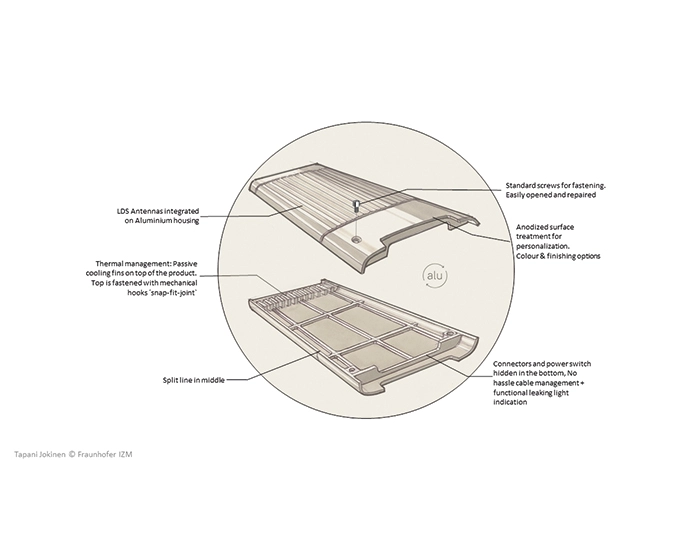
Circular Wi-Fi routers with sustainable aluminum bodies: A concept study of the aluminum body – the identical shape of the top and bottom pieces helps save time and costs in manufacturing. | © Tapani Jokinen
How does the ecodesign approach differ from previous product design?
According to Jokinen, the design process for consumer and industrial products has changed fundamentally. Conventional product design takes customers needs and technical requirements into account. Ecodesign expands this to include environmental and social aspects throughout the entire product lifecycle.
Jokinen emphasizes: »As a product designer, it is necessary to consider the entire system and its impact throughout its lifetime. Circular design considers value cycles in order to minimize environmental impact, reduce waste during production and disposal, and at the same time maximize value for manufacturers, users, and recyclers.«
This approach encompasses material selection, resource-efficient manufacturing, distribution, use, repair, and recycling. The goal of circular design is to significantly extend the service life of electronic products through robust materials, easy maintenance, and updates.
Numerous players are involved in the value chain. This is why Jokinen’s principle is »follow the money« in order to create economic incentives for all parties involved. He refers to durable materials: »Aluminum is a valuable material that basically lasts forever.« He adds: »We are developing innovative strategies to create closed-loop systems wherever possible.«
Conclusion and outlook
Jokinen sums up the project as follows: »The Alu4CED project stands out because of its multidisciplinary approach. It combines the expertise of designers, engineers, users, and stakeholders with a focus on sustainability.« The insights gained and solutions developed form the basis for future, sustainable product generations.
»ALU4CED« (»Aluminum based multifunctional housing for circular electronic devices«)
Duration: 10/2023 – 09/2025
Funding: Alliance for Industrial Research (AiF) and Collective Research Networking (CORNET) funded by the Federal Ministry for Economic Affairs and Climate Protection (BMWK)
Funding volume: approximately €1.1 million
Project partners: Fraunhofer IEM, Fraunhofer IZM, Łukasiewicz Research Network – Tele and Radio Research Institute ITR, Łukasiewicz Research Network – Institute of Non-Ferrous Metals
Associated partners: Research Association for Spatial Electronic Assemblies (3-D MID e.V.) and the Polish Chamber of Commerce for Electronics and Telecommunications
The ALU4CED project was awarded the Gold Medal for Innovation at the Kaohsiung International Invention & Design EXPO (KIDE 2024) in Taiwan. This award underscores the relevance of sustainable design approaches in electronics.
Publications:
Marek Kościelski, Lutz Stobbe, Thomas Mager, Tapani Jokinen, Adelja Schulz und Andrzej Kiernich, »ALU4CED – New concept for circular electronic design based on aluminium«, 2024 Electronics Goes Green 2024+ (EGG) ; 1-7 IEEE, June 18, 2024
Lutz Stobbe, Paul Schuster, Tapani Jokinen, Thomas Mager, Bruno Mecke, Marek Kościelski and Wojciech Szymański, »Aluminum-based multifunctional housing for circular electronic devices«, 14th International Symposium on Environmentally Conscious Design and Inverse Manufacturing (EcoDesign2025), November 2025
Sources:
¹ Plastics Europe: The Circular Economy for Plastics – A European Analysis – March 2024 (p.19)





 Prof. Dr.-Ing. Eckart Hoene
 Prof. Dr.-Ing. Ulrike Ganesh
 Karl-Friedrich Becker
 Steve Voges
Add comment